| In this issue:
Golden Eagle Camp - Great fishing for
Northern Pike, Walleye, Smallmouth Bass and other pan fish in the
famous Montreal River system. We’re surrounded by many remote lakes
to plan your daily fishing adventures. Complete packages available
with meal plan, boat & motor, all equipment, bait and ice included.
Plan this year’s vacation with us for fishing, bear hunting,
moose hunting and great snowmobiling!
|
Triggering
Crappie
By
Tim Allard
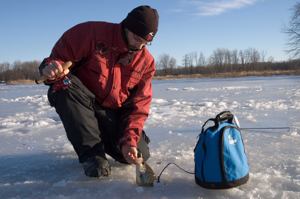 Crappies
are a great species to target through the ice. At times they can be
challenging to find, but worth the effort once you locate a school
of slabs. Often eager to investigate lures, crappie can be wary to
hit baits and, even then, takes can be extremely subtle. Here are
some hints on how-to trigger crappie into biting this ice season. Crappies
are a great species to target through the ice. At times they can be
challenging to find, but worth the effort once you locate a school
of slabs. Often eager to investigate lures, crappie can be wary to
hit baits and, even then, takes can be extremely subtle. Here are
some hints on how-to trigger crappie into biting this ice season.
From
Curiosity to Commitment
I've lost count of the number of times I've watched crappie on my
Vexilar hastily close in on a bait, only to stop within a few inches
and not hit. This can be discouraging; however, drawing them in is
the first step in getting crappie to bite. Attracting crappie means
your presentation has appealed to their curiosity, now you've got to
get them to commit and hit the bait. This is where a Vexilar is
helpful to monitor how crappie react to you're presentation, giving
you instant feedback on what's working and what isn't.
Once
crappies are close, getting them to hit is a matter of trying
different presentations until one works. For the most part, larger
movements, like one-foot jigging lifts, will attract crappie, while
pauses between jigging movements and the occasional jiggle will
trigger hits. Slowly swimming or hopping the bait upwards and away
from a marked fish is another tactic to force crappie to either hit
the bait or watch a meal disappear. If unable to trigger a fish with
the methods above, I've had success with the following.
Assuming
you've marked a fish on a flasher that won't hit, raise the bait to
the surface and then let it free-fall. Monitoring the lure's depth
on the flasher, stop the bait a foot or so above the fish and don't
move it. Often they hit it as soon as it stops and sometimes will
swim up to hit the bait on its long descent. For negative-mood fish,
adapt the above by slowly swimming the bait down on a controlled
drop instead of an open bail free-fall. Jiggling the bait after the
fall-and-pause approach might trigger hits.
Finer
Details
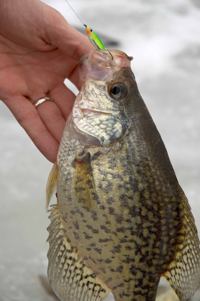 Lure selection can be critical to triggering hits. One outing last
season, I tried three different types of jigs before I could
convince a school of crappie to bite. But the action was hot once I
discovered the right bait. It would have been a miserable outing if
I hadn't have changed jigs and experimented with my presentation. In
this case, paying attention to details resulted in a great catch. Lure selection can be critical to triggering hits. One outing last
season, I tried three different types of jigs before I could
convince a school of crappie to bite. But the action was hot once I
discovered the right bait. It would have been a miserable outing if
I hadn't have changed jigs and experimented with my presentation. In
this case, paying attention to details resulted in a great catch.
If using
horizontal jigs, make sure the knot is centered so when the bait's
stationary it rests straight and not on an angle. Just as important
is tying a swivel a few feet up the line to prevent line twist so
lures won't spin when at rest. Keeping hooks ultra sharp is also
important to hooking fish. Lastly, it's best to tip lures with some
form of bait, whether real live bait or artificial products as scent
is a big factor in getting neutral or negative mood fish to hit.
Gear
I love fishing in my portable shelter. It blocks wind, letting me
watch the line for crappie's subtle hits and concentrate on
presenting baits. Of course on mild days, it's fun to hop from hole
to hole in bays looking for active fish. In both cases using a
spring bobber can help you spot light hits. HT Enterprises' new
"Big-Eye" spring bobber takes longer to freeze than traditional
coiled springs, making them ideal for cold temperatures or
unsheltered fishing.
Low-stretch, light line from two- to four-pound test is recommended.
Light line won't spook fish, but it also stays straight when fishing
micro baits. Too heavy a line won't fully uncoil if using light
lures. A light to ultra-light, graphite rod with a fast tip to
signal hits is a good choice. Make sure you pick one with enough
backbone to muscle a crappie through the hole.
To be an
effective crappie angler you need the right tools and need to be
willing to experiment with baits and presentations. Paying attention
to small details and how you present lures is critical to getting
crappie to hit. It might take a few attempts, but once you figure
out what they want, crappie fishing can be fantastic.
|